
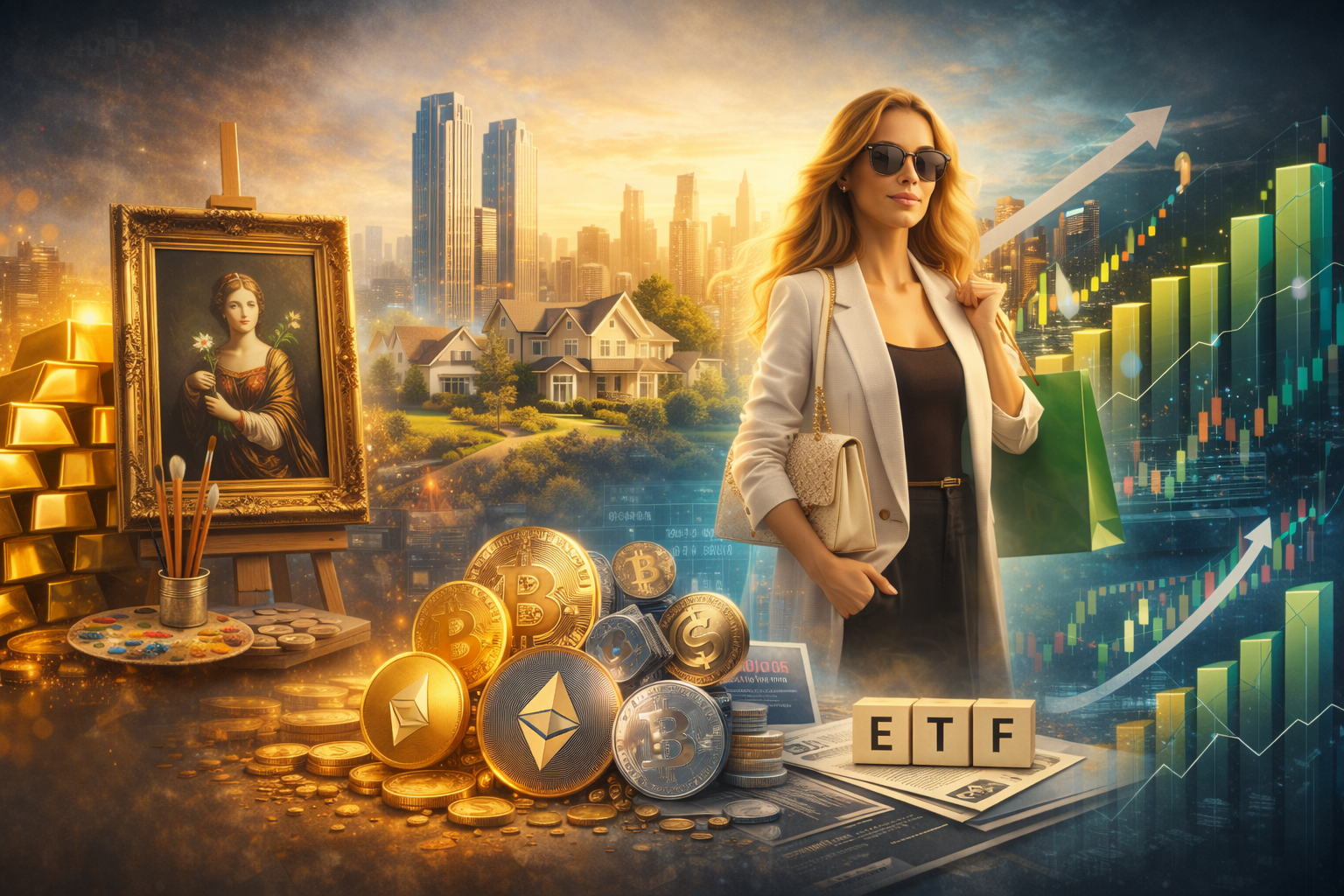
Imagine a regular grocery store.
You walk in, and in front of you are several aisles. Each one has something different. Dairy products in one aisle, bread in another, household cleaning products somewhere else.
Nobody puts laundry detergent next to the yogurts, right?
Investing works exactly the same way.
Different assets (the things you can invest in) fall into different categories. And before you buy anything, before you put your hard-earned money anywhere, you need to know which aisle you are standing in. Some of the questions you may ask yourself:
What is it?
How does it work?
How much is it worth?
And does it actually make sense?
Let me briefly walk you through a few of these “aisles” so it becomes easier to understand.
Before You Invest: Three Rules You Need to Know
Before we move on to specific types of investments, I want to tell you about the principles I use myself and teach women inside my program.
Smart investing is not about luck.
It is not about hot tips from a friend.
It is about having rules and sticking to them.
Simple rules.
Rule #1: Do I Understand This?
Sounds simple.
But believe me, most people do not do this.
If you do not understand what you are investing in, you will be stressed. You will make emotional decisions. You will sell in a panic when the price drops, and buy in excitement when everyone around you is screaming that this is a guaranteed win.
That is why before I invest, I make the effort to understand what I am investing in.
Without understanding, there is no good sleep.
And I want you to sleep peacefully.
Rule #2: Are My Investments Safe?
Maybe I am boring, but I like my money to be safe.
That is exactly why I want to understand my investment decisions: when it makes sense for me to invest, and what I should to invest in.
I do everything I can to make my investments as smart and as safe as possible.
And here is an important note: “safe” does not mean “zero risk.” No investment is completely risk-free. But when you invest wisely, you minimize that risk as much as possible.
On one side, there is knowledge, numbers, and facts.
On the other side, there is hope and keeping your fingers crossed.
Where there are numbers and knowledge, there are profits.
Where there is only hope, there is enormous risk and stupid losses.
And that is exactly what I want to protect you from.
Rule #3: How Much?
This is a very important question for me.
How much does something cost?
How much is it really worth?
How much can I pay?
How much can I earn?
How long will it take?
These are the questions I ask myself with every investment.
And this is why my investments generate profit, and my capital keeps growing.
Notice that there is no room here for guessing or hoping that things will somehow work out. I protect myself and my money and that is why my money is safe and works hard for me.
You should be asking these questions too.
Because you do not want to overpay.
You do not want to buy something that has no real chance of making you money.
You want to know what you put in has the potential to bring you real returns.
So let’s look at what you can invest in.
Gold
A lot of people talk about gold.
“A safe haven.”
“Value that lasts forever.”
But let’s pause for a moment.
How much is gold worth?
As much as people are willing to pay for it.
It is not a number you can calculate. It is pure speculation based on market sentiment.
Gold does not produce anything. It does not earn money. I do not have tools that allow me to assess whether today’s price is good, or whether gold will be higher or lower a year from now.
Personally, I do not invest in gold.
Too many question marks, not enough specifics.
But that is my personal assessment.
You need to draw your own conclusions.
Art and Paintings
Yes, paintings can increase in value. Some of them incredibly so.
But which ones?
When?
And by how much?
To invest well in art, you need to truly understand it.
And I mean truly.
I did my research, and for me, this aisle is closed.
There are too many unknowns.
If you know this world well, maybe it could be something for you. But going into it without knowledge?
No.
Bonds
Bonds seem safe.
After all, they are issued by the government, and the government guarantees repayment. And yes, they are a relatively safe option.
But for me personally, that is not enough.
The returns are low. It simply does not make sense for me to keep my money there when I know I can achieve much more using other methods.
I am not saying bonds are bad.
I am saying they are not good enough for me.
Real Estate
There is one very important nuance here that very few people say out loud.
A property you buy in order to LIVE in it is not an investment that puts money into your pocket.
It is an investment that takes money out of your pocket.
Taxes. Renovations. Maintenance fees. Insurance.
Yes, the value may increase if you bought in a good location, but in the meantime, you are paying.
For a property to be a real investment, it has to generate income, for example, through renting it out.
On top of that, real estate requires significant starting capital. That barrier simply exists.
So if you are already sitting on substantial money, you understand real estate, and you are happy with the return on investment you can get, then it may be an idea for you.
Handbags, Clothes, Cosmetics
Yes, I know.
We laugh, but this is actually an interesting topic.
When we buy expensive things, we put money into them. Some of them may increase in value: collector’s handbags from luxury brands, limited editions, rare pieces.
But pay attention: these are exceptions, not the rule.
Most things we buy lose value the second we leave the store.
And we often do not notice that we have invested money into a few moments of pleasure.
I make these kinds of purchases only after I have earned money from my investments.
Not before.
That is the order I stick to.
Grow my profits.
Then spoiling myself.
Cryptocurrencies
This is a topic that creates a lot of emotion.
And I understand why.
The promise of becoming a millionaire, and quickly, too.
My personal assessment: this is a very risky investment.
Why?
Because I do not know how much something is really worth. I do not know how it will behave. Crypto does not produce anything. It has no cash flows I can measure.
There is a huge amount of speculation and a lot of “keeping your fingers crossed.”
And becoming a millionaire?
Many people love the idea of putting in one thousand dollars and becoming rich.
But it is worth using mathematics and checking what exactly would need to happen, how much you would actually need to put in, and what kind of risk you would be taking.
Maybe for you, if you know how to navigate this world well, it can be a good investment.
For me, it is not.
ETFs
An ETF is a basket of stocks.
You buy one unit that reflects several companies at once.
It is a popular option, and I understand why. In theory, it is simple, at least that is how it is often sold. It is diversified and relatively cheap to manage.
But once again, I will be the voice of reason here: even if you want to invest in ETFs, you still need to gain knowledge.
And that is why, when I have a choice between ETFs and stocks, I choose stocks.
Why?
Because no ETF will give me the same returns as well-selected individual stocks.
An ETF moves up and down together with the broader market.
A good stock can grow by several hundred percent.
Stocks: My Number One
A stock is a piece of a real business.
A company goes public, divides itself into millions of tiny pieces, and you can buy one of them.
What does that mean in practice?
It means that the company works for you.
You do not have to sell anything.
You do not have to serve customers.
You do not have to issue invoices.
The company earns money, and you, as its co-owner, have a share in that.
Of course, for this to work, you need to know which companies to choose. When to buy. How much they are worth. What you can expect.
The women who learn investing with me are able to generate even over 300% in a year.
This is not magic.
This is knowledge and a specific strategy.
To Sum It Up
You can invest in many different things, as long as you understand the rules and choose something that matches your financial expectations.
Because not every asset is created equal.
It is worth checking your options and understanding how quickly, or how slowly, your wealth can grow.
Ania Witowska – financial educator and creator of the Mądra Inwestorka program, which helps women build financial independence through investing.